Who this card is for
A good fit if you…
- Households that spend enough on groceries and gas for 3% to clear a Platinum fee once the first-year rebate ends, but cannot (or would rather not) clear Visa Infinite income.
- People who also dine out, ride transit, and pay recurring bills, and can park those on the same card for 2%.
- Applicants who meet the household income figure in eligibility and have not opened, transferred, or cancelled another Dividend card in the last 12 months if they want the welcome offer.
- Cash-back fans who bank at CIBC and do not want to learn Aeroplan for an everyday card.
Skip it if you…
- Applicants who already meet Infinite income and whose grocery bill is large. Dividend Visa Infinite currently lists 4% on the same supermarket and fuel stack.
- Light grocery spenders. If the supermarket is not a major bill, year two of this fee is a membership the $0 Dividend Visa would have skipped.
- Air Canada collectors who applied for the wrong CIBC card. That is an Aeroplan product, not Dividend.
- Anyone who revolves a balance. 3% groceries will not outrun the purchase rate.
Pros and cons
Pros
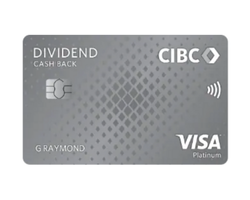
- 3% cash back on eligible grocery, gas, and EV charging is a step up from the no-fee Dividend Visa’s 2% supermarket rate without requiring Infinite income.
- 2% on commuter transit, restaurants, recurring payments, and eligible CIBC-by-Expedia travel matches Infinite’s secondary stack in the card’s features, just beneath a lower grocery headline.
- 1% on everything else is a respectable catch-all for a paid cash-back card.
- The current welcome mix stacks a 10% grocery-and-spend bonus, a small pre-authorized-payment bonus, and a first-year annual-fee rebate.
- Additional cards currently have their first-year fee rebated as well, up to a small number of extras.
Cons
- After year one, the annual fee returns unless a new promotion says otherwise. Grocery spend has to keep working at 3%, not Infinite’s 4%.
- Merchant coding is strict in the detailed features: grocery means grocery stores and supermarkets, gas means service stations and EV charging with a listed MCC, and “recurring” means the merchant flags it as recurring.
- Warehouse clubs, restaurants inside grocers, and travel booked outside CIBC by Expedia are easy ways to miss the bonus rate.
- Eligibility currently blocks people who opened, transferred, or cancelled another Dividend card in the last 12 months — including a product-change from the $0 Visa or a run at Infinite.
- Check the issuer’s site for current insurance coverage. Do not assume travel medical coverage from the Platinum name.
Fees and value: is the annual fee worth it?
First-year snapshot (estimate)
- Annual fee
- $99
- Estimated welcome bonus value
- $400
- Bonus minus fee (estimate)
- $301
This is a simple comparison of the estimated welcome-bonus value against the annual fee. It ignores rewards on spending, credits you have to remember to use, and interest if you carry a balance. Offers change — verify with the issuer.
The fee table shows a $99-class Platinum card; the detail line currently says the first year is rebated. The first-year snapshot on this page will look generous if you treat the rebate as part of welcome value, because our estimated bonus figure already includes that rebate.
Year two is the full fee versus 3% groceries and gas plus 2% on the secondary categories. Do the boring math: grocery and gas times 3%, plus dining/transit/bills times 2%, plus 1% on the rest, minus the ongoing fee.
If that net is smaller than the no-fee Dividend Visa or a $0 card like Tangerine, do not keep Platinum for the metal. If Infinite income is already in hand and the supermarket is huge, the extra grocery point on Infinite is the comparison that matters.
Additional cards currently show a fee that is also first-year rebated. Offers change.
Pay in full.
Rewards and earn rates explained
Rewards program: Cash Back
This card pays cash back, not points. The current stack is 3% on purchases at merchants classified as grocery stores and supermarkets, or as gas service stations, automated fuel dispensers, and electric-vehicle charging with the MCC called out in the detailed benefits; 2% on Canadian commuter transportation (subway, streetcar, taxi, limousine, rideshare — not air, car rental, or cruises), eating and drinking places, recurring payments the merchant classifies as recurring, and eligible CIBC-by-Expedia bookings; and 1% on everything else.
Infinite currently prints 4% on that same grocery/gas/EV list. The no-fee Dividend Visa currently prints 2% groceries, 1% on the secondary list, and 0.5% elsewhere.
Those definitions are specific: Costco, a superstore that codes as a mass merchant, or a meal-kit company can miss 3%. Redeem as cash back according to CIBC’s rules.
Welcome bonus: how to unlock it
Earn up to $400 in value
The current offer has three parts: a 10% cash-back welcome on net purchases up to a listed cap over the first four statements, a smaller cash bonus for setting up one pre-authorized payment in that same window, and a first-year annual-fee rebate. You need the spend, the PAP, and the rebate to match the “up to” value.
Eligibility currently says CIBC may approve you and still withhold the offer if you opened, transferred, or cancelled another Dividend card in the last 12 months, and that transfers and product-changes from other CIBC cards are excluded. That includes moving from the $0 Dividend Visa.
Hit the 10% cap with grocery and gas you would buy anyway; do not add a fake pre-authorized payment you will forget to cancel.
Welcome bonus eligibility: Offer applies to newly approved card accounts only. Transfers and product changes from other CIBC credit cards are excluded from this offer. CIBC may approve your application, but you are not eligible to receive this Offer if you have opened, transferred or cancelled another Dividend card within the last 12 months.
FAQ
Is the CIBC Dividend Platinum Visa Card worth it in 2026?
It is worth it when grocery and gas spend is high enough that 3% minus the ongoing fee still beats the $0 Dividend Visa, and when Infinite income is not available. It is not worth it as a 4% Infinite substitute or as a card for someone who picks up groceries once a week on a small bill.
Dividend Platinum vs Dividend Visa Infinite vs the no-fee Dividend Visa?
Infinite currently lists 4% grocery/gas at a higher fee and Infinite income. This Platinum card currently lists 3% at a lower fee and a much lower household income bar. The no-fee Dividend Visa pays 2% groceries and 1% on several everyday categories. Pick the lowest rung that still matches spend and what you can pass.
CIBC Dividend Platinum vs TD Cash Back Visa Infinite?
TD Cash Back Visa Infinite pays 3% on a broader stack that includes streaming and digital media, with Infinite income. Platinum currently pays 3% at the supermarket and gas pump and 2% on transit/dining/bills, at a $15,000-class household bar.
Choose CIBC Platinum if Infinite income is the blocker and grocery is the bill. Choose TD Infinite if you already qualify and streaming/bills are as large as the shop.
Is the annual fee waived in the first year?
Our current annual-fee detail and welcome wrap both describe a first-year rebate. That is an offer, not a permanent $0 card. Confirm it on CIBC’s page, and budget for the full fee in year two.
Does this card charge foreign-exchange fees?
Most Canadian Platinum Visas add a foreign-conversion fee on foreign-currency purchases. Dividend Platinum is a grocery cash-back card, not a no-FX travel card. For overseas spend, compare Scotiabank Passport Visa Infinite, and confirm CIBC’s current FX rate in the agreement.
Compare related cards and guides
More Canadian credit card lists that match this product, plus a few cards people usually compare it with.
- CIBC Dividend Visa Infinite Card review · CIBC · $120 annual fee
- CIBC Dividend Visa Card review · CIBC · $0 annual fee
- TD Cash Back Visa Infinite Card review · TD · $139 annual fee